
If you have ever tried to import goods from overseas and found yourself staring blankly at a shipping quote that says “FOB Shanghai” or “FOB Karachi”, and you don’t know what is FOB shipping, you are not alone. Most first-time importers have absolutely no idea what FOB means, and frankly, many experienced ones get it wrong too.
Here is the thing though, understanding FOB can save you thousands of dollars on your next shipment. Get it wrong and you could end up paying for damages, delays, or losses that were never supposed to be your responsibility in the first place.
In this guide we are going to break down FOB shipping in plain, simple English, no jargon, no confusion. By the end of it you will know exactly what FOB means, when to use it, when to avoid it, and how to protect yourself when negotiating with overseas suppliers.
Let’s get into it.
What Does FOB Shipping Stand For?
FOB stands for Free On Board. It is one of the most commonly used Incoterms, short for International Commercial Terms, which are a set of globally recognized rules that define the responsibilities of buyers and sellers in international trade.
In simple terms, FOB tells you exactly the point at which the risk and cost of a shipment transfers from the seller to the buyer.
I remember the first time I explained FOB terms to a client at Maersk where the importer was based in the UK. He initially believed the seller in Pakistan would remain responsible for the shipment all the way until it arrived at his warehouse in London. I had to walk him through the actual meaning of FOB step by step, explaining that under FOB (Free On Board), the seller’s responsibility ends once the cargo is loaded onto the vessel at the port of origin.
To make it easier for him to understand, I gave a real example from one of our export shipments. I explained that if the cargo was being shipped FOB Karachi, the Pakistani exporter would handle local transportation, export clearance, and loading the container onto the vessel at Karachi Port. But the moment the container crossed the ship’s rail, the responsibility shifted to the UK importer, including ocean freight, insurance, destination charges, customs clearance in the UK, and final delivery.
That conversation actually changed how he negotiated future contracts with suppliers. Once he understood FOB properly, he started arranging his own freight through his UK forwarder because he realized he could get better shipping rates and more control over transit times. Sometimes, a simple explanation of Incoterms can completely change how businesses manage international trade.
FOB Shipping Explained in Plain English
Think of it this way. Imagine you are buying a large order of furniture from a manufacturer in Vietnam. You agree on FOB Ho Chi Minh City as the shipping term.
Here is what that actually means:
- The seller (Vietnamese manufacturer) is responsible for getting the goods to the port in Ho Chi Minh City, clearing them through Vietnamese export customs, and loading them onto the ship.
- The moment those goods are loaded onto the vessel, that is it. The risk passes to you.
- From that point onward you (the buyer) are responsible for the ocean freight, insurance, import customs clearance, and delivery to your warehouse.
That’s FOB in a nutshell. Simple, right?
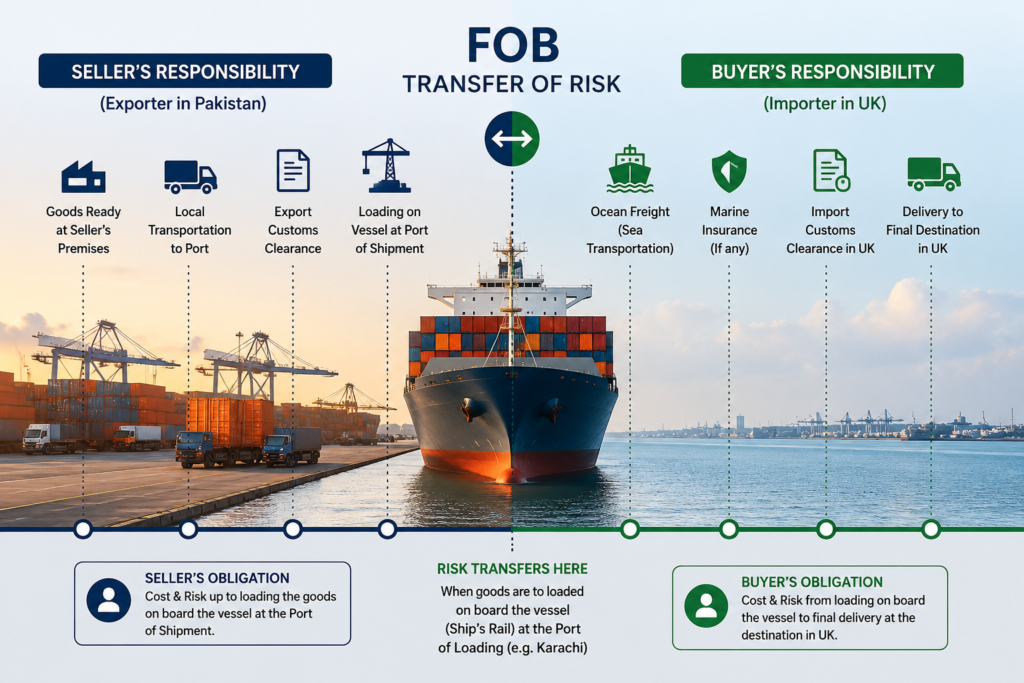
To better understand the concept we’ve explained so far, please see the infographic below that visually breaks it down.
The Exact Point of Risk Transfer Under FOB Shipping
This is where many people get confused so let’s be very precise about it.
Under FOB terms the risk transfers from seller to buyer at the ship’s rail, meaning the exact moment the goods are loaded onto the vessel at the origin port.
Before loading onto the ship, seller’s risk and cost ends. After loading onto the ship, buyer’s risk and cost starts.
In practice, this is one of the most commonly disputed points in international trade. From a logistics perspective, it often comes down to precise documentation at the time of handover and how clearly responsibilities are defined under the agreed Incoterms. In many real-world cases, small gaps in communication between buyer, seller, and carrier are what turn a routine shipment into a costly claim situation.
What Does FOB Include and Exclude?
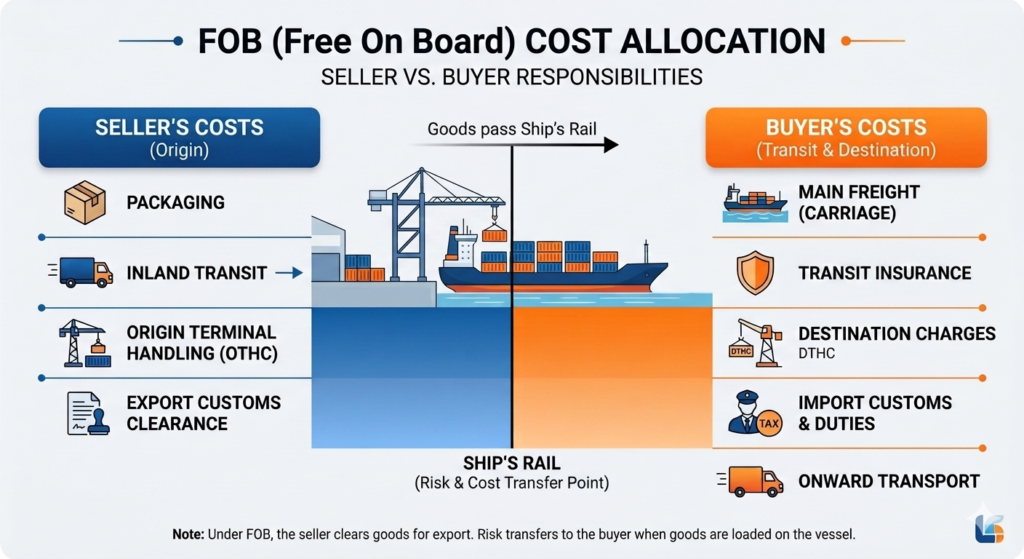
What the SELLER pays for under FOB:
- Cost of manufacturing and packaging the goods
- Transportation from factory to the origin port
- Export customs clearance and documentation
- Port handling charges at origin
- Loading the goods onto the vessel
What the BUYER pays for under FOB:
- Ocean or air freight from origin port to destination
- Marine cargo insurance
- Customs duties and taxes at destination
- Port handling charges at destination
- Delivery from destination port to your warehouse
FOB vs Other Incoterms | What’s the Difference?
FOB is just one of eleven Incoterms. To understand where it sits let’s quickly compare it to two of the most common alternatives:
FOB vs CIF (Cost, Insurance and Freight)
Under CIF the seller takes responsibility for the ocean freight and insurance all the way to the destination port. Under FOB you as the buyer arrange your own freight and insurance from the origin port.
Which is better?
FOB generally gives the buyer more control and often works out cheaper, because you can negotiate your own freight rates directly with your preferred carrier. CIF puts the seller in control of freight which sometimes means higher costs hidden in the price.
FOB vs EXW (Ex Works)
Under EXW the seller’s responsibility ends the moment the goods leave the factory gate. You as the buyer are responsible for literally everything, including getting the goods from the factory to the port and handling export customs.
FOB is generally better than EXW for buyers who don’t have a local agent or freight forwarder in the origin country, because under FOB the seller handles the export side.
When Should You Use FOB?
FOB works best when:
- You have an established relationship with a reliable freight forwarder who can handle the shipment from the origin port
- You are importing large volumes and want to negotiate your own competitive freight rates
- Not sure about shipping costs? Read our guide on How Small Businesses Can Reduce Shipping Costs in 2026
- You want full visibility and control over your shipment from the moment it leaves port
- You are importing from a country where you trust the seller to properly load the goods
FOB was almost always the recommended term for experienced British buyers importing from Asia because it prevents unexpected UK destination port fees and shields the buyer from complex foreign local logistics.
When a UK business buys on CFR or CIF terms from a manufacturer in Shenzhen or Ho Chi Minh City, the Asian supplier controls the ocean freight booking. To minimize their own costs, suppliers often choose budget consolidation services. While the upfront invoice looks cheap, the UK importer faces a rude awakening when the vessel arrives at ports like Felixstowe, Southampton, or London Gateway. The local UK handling agents frequently demand inflated, non-negotiable UK Deferment, Documentation, and Terminal Handling Charges (DTHC) before releasing the delivery.
By purchasing on an FOB origin port basis, the UK buyer gains strategic advantages:
- Nominated Forwarder Control: The importer nominates their own UK-managed freight forwarder to handle the sea freight.
- Transparent VAT & Duty Management: Having a domestic agent streamlines the submission of UK customs declarations through the Customs Declaration Service (CDS), facilitating smooth EORI number verification and Postponed VAT Accounting (PVA).
- Predictable Supply Chain: The buyer dictates the exact transit timeline and avoids the hidden destination margins that routinely plague European imports.
When Should You AVOID FOB?
FOB is not always the right choice. You should Avoid it when:
- You are a first-time importer with no freight forwarder relationship in place yet, the logistics can get overwhelming quickly
- You are importing small quantities where the cost savings from negotiating your own freight are minimal
- Your supplier is in a country where export procedures are complex and you don’t have local knowledge
- You are buying from a supplier you don’t fully trust, under FOB you have no visibility until the goods are already on the ship
The most common mistake I’ve seen first-time importers make is agreeing to FOB terms without having a freight forwarder ready on their end. I’ve seen shipments sit at origin ports for weeks because the buyer assumes the seller handles everything, forgetting that someone must actually book the vessel space.
One new importer left their cargo stranded in a congested Asian holding yard for three weeks while frantically searching for a logistics provider. By the time they secured a booking, massive origin storage and demurrage fees had completely wiped out their profit margins before the ship even sailed.
The Most Common FOB Mistakes Importers Make
After years in the logistics industry, these are the mistakes I see over and over again:
Mistake 1 | Confusing FOB with FCA
Here is a little-known fact that the International Chamber of Commerce actually recommends using FCA (Free Carrier) instead of FOB for containerized shipments. The reason is technical but important: under modern container shipping, the goods are handed over to the carrier at the container terminal before they are actually loaded onto the ship—which creates a grey area under FOB terms. Most shipping professionals still use FOB, but be aware of this nuance.
Mistake 2 | Not checking what “FOB” means to your supplier
Believe it or not, different countries and suppliers sometimes interpret FOB slightly differently. Some suppliers quote “FOB” but include additional charges at the port that they spring on you at the last minute. Always confirm in writing exactly what is included in your supplier’s FOB price.
Industry Insight: This happened to a client of mine once, their supplier quoted FOB Guangzhou but then added unexpected port handling fees that weren’t discussed upfront. It delayed the entire shipment over a few hundred dollars because neither side wanted to claim the surprise invoice. Always get a detailed breakdown of port fees in writing before production starts.
Mistake 3 | Not having a freight forwarder lined up before agreeing to FOB
Your freight forwarder needs to be ready to receive the Bill of Lading details and arrange the next steps the moment your goods are loaded. Don’t agree to FOB terms and then scramble to find a forwarder.
The buyer assumes the seller handles everything up to departure, forgetting that someone must actually book the vessel space. One new importer left their cargo stranded in a congested Asian holding yard for three weeks while frantically searching for a logistics provider. By the time they secured a booking, massive origin storage and demurrage fees had completely wiped out their profit margins before the ship even sailed.

How FOB Works Step by Step | A Practical Example
Let’s walk through a real-world FOB shipment from start to finish.
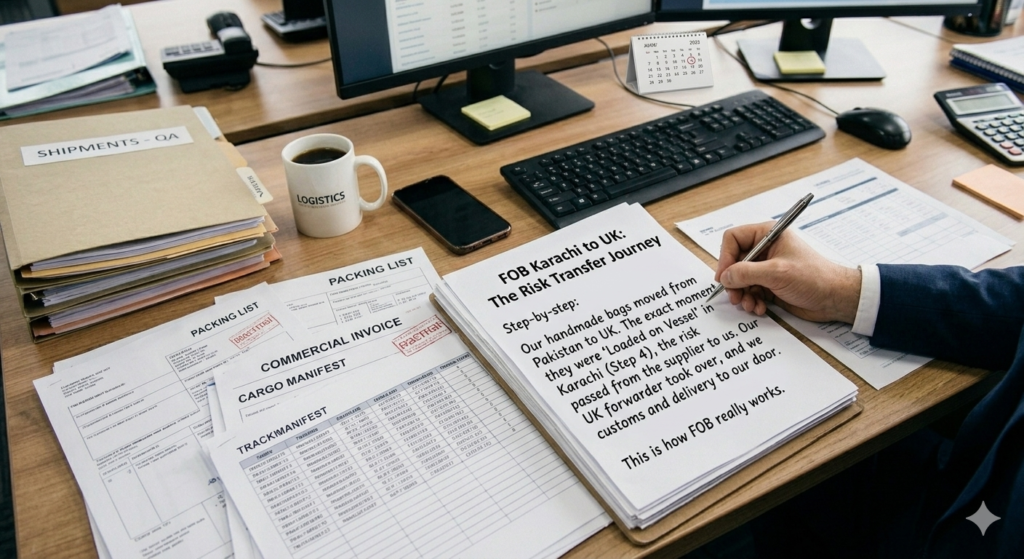
Scenario: You are a UK business owner importing 500 units of handmade leather bags from a supplier in Pakistan on FOB Karachi terms.
- Step 1 : Purchase Order: You finalize the contract with your Pakistani supplier under FOB Karachi terms.
- Step 2 : Production: The factory manufactures and packages your 500 leather bags.
- Step 3 : Origin Port Delivery: The supplier trucks the cargo to Karachi Port and clears export customs in Pakistan.
- Step 4 : Loading the Vessel: The goods cross the ship’s rail. At this precise second, all risk transfers entirely to you.
- Step 5 : Forwarder Takeover: Your UK freight forwarder receives the Bill of Lading to coordinate ocean transit.
- Step 6 : UK Port Arrival: Your forwarder manages UK customs clearance and settles the mandatory UK import duties.
- Step 7 : Final Delivery: The logistics agent completes the final leg, delivering the 500 bags to your UK warehouse.
Industry Reflection: This timeline is exactly how hundreds of shipments I’ve managed over the years worked. The beauty of FOB when it runs smoothly is that both sides know exactly what they are responsible for. The factory handles local transport and export red tape, while you retain complete authority over your shipping rates, ocean timeline, and domestic clearance agents without surprise supplier markups.
FOB Price | What Does It Include?
When a supplier quotes an “FOB price,” it represents the total cost to get your goods produced, exported, and physically loaded onto the ocean vessel.
📦 What It Includes:
- Cost of goods | The actual manufacturing cost of your items.
- Packaging | Export-ready boxing, labeling, and palletizing.
- Inland transportation | Trucking from the factory floor to the departure port.
- Export customs clearance | Local government paperwork, taxes, and declaration fees.
- Origin port handling | Terminal handling charges (OTHC) and loading fees onto the ship.
❌ What It Does NOT Include:
- Ocean freight | The main international sea or air carriage fees.
- Import customs clearance | Destination broker fees, duties, and local taxes.
- Final delivery | Onward trucking from your domestic port to your warehouse floor.
Pro Tip: Always make sure you are comparing apples to apples when analyzing vendor bids. A supplier quoting EXW (Ex Works) $10 per unit might initially look cheaper than one quoting FOB $12 per unit. However, once you manually calculate the hidden local trucking and export customs costs to get those EXW goods from the foreign factory to the port, the FOB quote is frequently the more economical and less stressful choice.
FOB and the Bill of Lading | What You Need to Know
Under FOB terms, you as the buyer should be listed as the consignee (or your agent as the notify party) on the Bill of Lading (B/L)—the absolute master document of any ocean shipment.
The Bill of Lading is your ultimate proof of cargo ownership while it is at sea. Without it, you legally cannot claim your goods at the destination port.
Industry Reflection: In my Maersk days, the original Bill of Lading was something we treated with the exact same seriousness as a physical bank check [1]. It is a document of title. I once watched an importer lose access to an entire container of high-value goods because they misplaced the original paper set during a messy courier handoff. Because they couldn’t produce the original B/L at the destination port, the shipping line legally could not release the container [1]. The cargo sat racking up devastating port storage fees for weeks while they scrambled to obtain a bank guarantee just to secure a replacement.
Always ensure your freight forwarder confirms the B/L setup early, and consider asking for a Telex Release (electronic release) if you want to avoid the risks of shipping physical paperwork across borders.
Frequently Asked Questions About FOB Shipping
Q: Does FOB include customs clearance?
Yes, FOB includes export customs clearance in the origin country. The seller is responsible for completing all local paperwork and paying local departure taxes. It does NOT include import customs clearance, duties, or local taxes at your destination port.
Q: Who pays freight under FOB?
The buyer pays for the ocean or air freight transportation. Your responsibility for shipping costs begins the exact second the goods cross the ship’s rail at the departure port.
Q: Is FOB good for small businesses?
It depends on your setup. FOB offers higher cost transparency and protects you from hidden destination fees, but it requires you to find and hire your own freight forwarder. For absolute beginners or very small express shipments, CIF (Cost, Insurance, and Freight) might feel easier to handle initially. You might also find our guide on What is LCL Shipping helpful if you are just starting out.
Q: What is the difference between FOB and FOB Destination?
Under standard international FOB (FOB Origin), risk transfers to you as soon as the cargo is loaded onto the ship at the export port. Under FOB Destination, the seller maintains full responsibility and liability for the cargo until it physically reaches your warehouse. FOB Destination is primarily utilized for domestic trade within the United States rather than global ocean freight.
Q: Can I use FOB for air freight?
Technically, no. The International Chamber of Commerce rules state that FOB is strictly meant for sea and inland waterway transport. For air cargo, the official matching term is FCA (Free Carrier). However, many global suppliers still loosely write “FOB” on air freight quotes to show they will pay for transport up to the local airport.
Key Takeaways
- Understanding what is FOB shipping, FOB stands for Free On Board and transfers all risk and liability from the seller to the buyer the moment goods are loaded onto the vessel.
- The seller manages local trucking, port handling, and export customs clearance. The buyer controls everything from the ocean journey up to the final warehouse floor.
- FOB grants buyers greater control over international shipping timelines and freight carrier pricing than seller-controlled terms like CIF.
- First-time importers should secure a trusted freight forwarder relationship before signing any FOB purchase agreement.
- Always verify in writing exactly what charges are included in your factory’s FOB quotation to prevent unexpected surprise fees at the terminal.
Final Thoughts
Many importers ask what is FOB shipping, and the answer is simpler than it sounds once you understand the basic principle: the seller gets it to the ship and you take it from there.
The key is to go into any FOB shipping agreement with your freight forwarder already lined up and a clear written understanding with your supplier of exactly what their local port price includes.
A Note From My Desk: After more than 20 years managing logistics and shipping lanes, I still firmly believe FOB shipping is one of the cleanest, fairest, and most transparent shipping terms for international trade. When both parties understand their side of the ship’s rail, it eliminates finger-pointing and keeps your supply chain highly efficient. If you are preparing a shipment right now and feel stuck on the paperwork or terms, don’t let it overwhelm you.
Found this guide helpful? Explore more logistics and shipping guides at WordCarriage.com : written by industry professionals with real-world experience.
Have a question about FOB or international shipping? Drop it in the comments below : we read and reply to every single one!
