
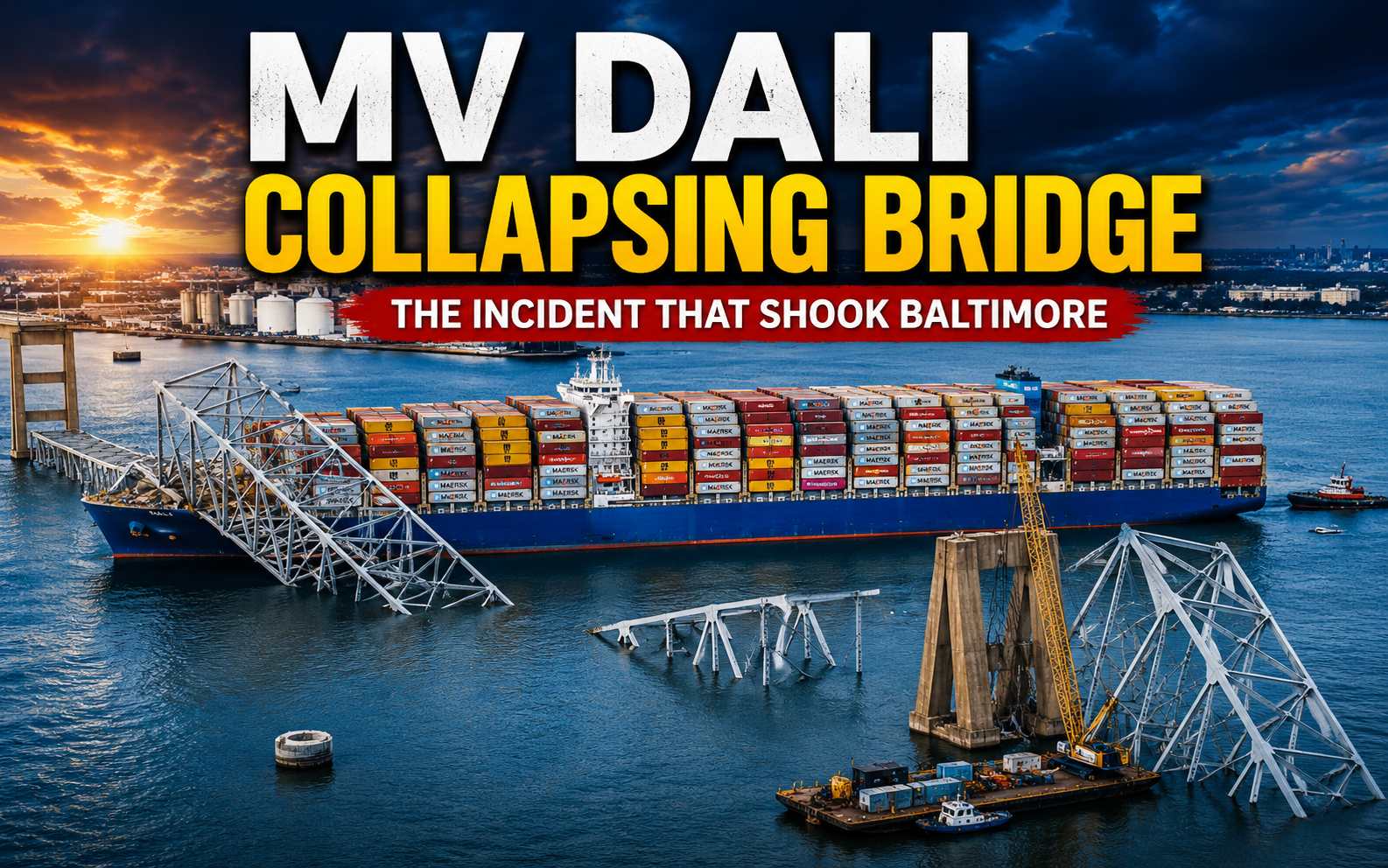
When the 984-foot container ship MV Dali lost power and struck Baltimore’s Francis Scott Key Bridge, the structural failure reverberated across the global shipping sector. Within seconds, a vital artery of U.S. logistics collapsed, highlighting deep vulnerabilities in modern infrastructure. Far from being a simple navigation error, official investigations reveal a complex chain of electrical oversight, hazardous shortcuts, and systemic regulatory gaps that are now forcing a total reinvention of maritime safety.
The Event: A Midnight Blackout on the Patapsco
On March 26, 2024, the Singapore-flagged vessel MV Dali initiated its departure from the Port of Baltimore, fully laden and bound for Colombo, Sri Lanka. At roughly 1:30 a.m., as the massive ship neared the Francis Scott Key Bridge, it suffered a sudden, catastrophic loss of electrical power and propulsion. Traveling at roughly 8 knots without steering control, the 100,000-ton cargo carrier drifted off course and struck the southwest main pier, causing the entire central truss span to collapse within moments.
The Root Cause: A Shaken Wire and Hidden Deficiencies
Initial public theories blamed contaminated fuel or human steering errors, but the National Transportation Safety Board (NTSB) investigation revealed that the true catalyst was a subtle electrical flaw. A single loose signal wire connection to an electrical terminal block triggered the initial blackout. Investigators discovered that a plastic wire-label sticker had been improperly installed over the base of the connector, preventing it from seating fully into place. Over time, the heavy vibrations of the ship’s massive diesel engine shook the loose wire free, instantly tripping the main circuit breakers and plunging the vessel into darkness.
The disaster escalated from a simple electrical failure into a major investigation due to unauthorized mechanical workarounds on board. Legal filings revealed that the ship’s operating company had been using an unapproved flushing pump to feed fuel to two of the ship’s main backup generators. Unlike standard, certified marine fuel supply systems, this specific setup lacked an automatic-restart safety function following an outage. When the initial blackout occurred, the unapproved pump shut down and stayed offline, starving the backup generators of fuel and causing a second catastrophic blackout that sealed the ship’s fate.
- The Failure Chain:
- Loose Wire Vibrates Free → Triggers initial shipboard blackout.
Backup Generators Activate → Automation tries to restore power.
Unapproved Flushing Pump Fails → Lacks auto-restart capability.
Generators Starve of Fuel → Induces a second catastrophic blackout.
Complete Loss of Steering Control → Vessel drifts into the bridge pier.
- Loose Wire Vibrates Free → Triggers initial shipboard blackout.
Immediate Logistical and Financial Fallout
The collapse triggered immediate, severe complications across international supply chains. As a leading U.S. gateway for automotive freight and heavy agricultural machinery, the sudden closure of Baltimore’s shipping channel forced logistics managers to quickly reroute thousands of containers to alternative East Coast ports like New York, Norfolk, and Savannah. Beyond immediate delays, rebuilding the iconic crossing requires massive capital; driven up by raw material costs, total reconstruction expenses are estimated near $5 billion, pushing completion timelines back to at least 2030.
Prevention and Policy Legacy: Changing Global Procedures
The MV Dali disaster serves as a permanent turning point for global shipping safety, prompting rapid changes across marine engineering, port operations, and civil infrastructure design. The NTSB issued 14 distinct marine safety recommendations focused on preventing power failures during tight maneuvers, prompting the global shipping community to reevaluate secondary electrical redundancy. Furthermore, the threat extends to shoreside infrastructure; transport departments have initiated structural reviews of major bridges featuring similar vulnerabilities, with port authorities quickly retrofitting older pylons with robust, energy-absorbing fendering systems and artificial rock islands to divert drifting ships.
| Core Metric / Factor | Details & Documented Impact |
| Vessel Involved | MV Dali (~100,000 tons displacement) |
| Primary Root Cause | Loose signal wire connection hidden by a misplaced connector label |
| Aggravating Factor | Unapproved fuel flushing pump failed to auto-restart during blackout |
| Human & Physical Cost | 6 fatalities; Complete destruction of the bridge truss |
| Economic Liability | $5B projected rebuild cost; Heavy corporate civil settlements |
